
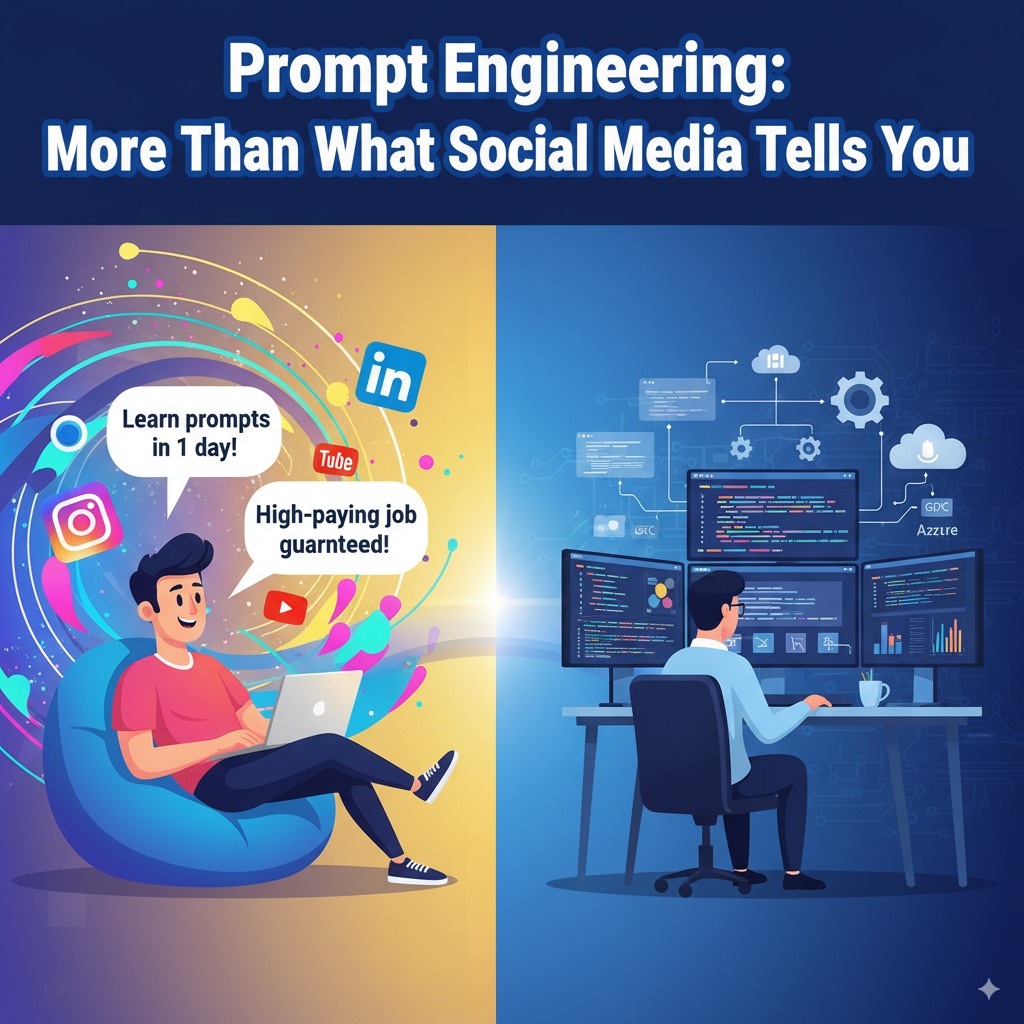
Lately, “prompt engineering” has become a buzzword in the tech world, amplified by the explosion of generative AI models like ChatGPT, Claude, Gemini. Scroll through LinkedIn, Instagram, or YouTube, and you’ll encounter countless ads and posts claiming that with a few simple techniques, you can become a prompt engineering expert and land a high-paying tech job. Sounds tempting, right? But the reality of prompt engineering is far more nuanced than what social media would have you believe.
🔹What Social Media Gets Wrong
The oversimplified narrative makes it seem as though prompt engineering is just about writing clever sentences or asking the “right” questions to get a large language model (LLM) to generate the desired output. Influencers and ads push the idea that attending a one-day workshop or learning how to create PowerPoint decks or Excel reports with ChatGPT qualify someone as a prompt engineering pro. If only it were that easy!
🔹If prompt engineering is so easy why would a company pay you lakhs for this simple skill?
The truth is, crafting good prompts is only a small part of the equation. If prompt engineering were just about clear communication, then every English teacher or native speaker would be a top-tier prompt engineer. Someone who works with AI models or any person with little common sense and curiosity knows it takes much more than that to get consistent, reliable, and context-aware results from AI tools out in the world.
🔹What Prompt Engineering Really Takes (Beyond Just Writing Prompts)
The Core Functional Requirements of a Prompt Engineer
Prompt engineering is a hybrid role that blends elements of software development, natural language processing (NLP), and continuous testing and iteration. Let’s break it down :
- Understanding Model Behavior: A solid grasp of how LLMs work under the hood helps predict and influence outputs. This requires some understanding of machine learning fundamentals, tokenization, and model training principles.
- Technical Integration: Many prompt engineering roles involve not just writing text but building automated pipelines that feed prompts into APIs, handle output formatting, and integrate with broader systems. Python scripting and working with OpenAI, Anthropic, or other APIs are often essential.
- Evaluation & Optimization: Knowing how to test, evaluate, and improve AI outputs is critical. This often means analyzing model responses for accuracy, coherence, and relevance, and iteratively refining both the prompts and the input data.
- Domain-Specific Knowledge: Creating effective prompts for software development, finance, healthcare, legal, or any specialized field requires domain expertise. General-purpose content generation prompts don’t cut it when precision is required. If one LLM can do all things in all domains, then for example a specific model for text generation, image generation and video generation would not have been developed.
- Problem-Solving Mindset: At its core, prompt engineering is about solving problems – whether that’s improving the performance of a chatbot, generating accurate data extractions, or automating creative content generation.
Some Technical Skills Required to be a Prompt Engineer
To thrive as a prompt engineer, there’s a deeper technical stack you’ll need beyond writing good prompts. Here are the essential skills which are also evolving as we read :
- Programming Languages: Proficiency in Python or a programming language is a must, as most AI model APIs and integrations are Python-based. Knowing JavaScript can also be helpful for building interactive AI-powered applications.
- APIs and SDKs: Understanding how to work with APIs from OpenAI, Hugging Face, and similar platforms. Knowing how to handle API tokens, rate limiting, and asynchronous requests is essential for production-level systems.
- Machine Learning Fundamentals: A working knowledge of NLP concepts, such as tokenization, embeddings, attention mechanisms, and transformer architectures, helps with model optimization and fine-tuning.
- Version Control: Familiarity with Git and GitHub is important for collaborating with teams, maintaining prompt versioning, and integrating AI workflows with larger codebases.
- Data Preprocessing and Cleaning: Experience with data analysis, data engineering or at least Pandas, NumPy, and data wrangling techniques ensures that inputs to the LLM are clean and optimized for consistent performance.
- A/B Testing and Experimentation: Knowing how to conduct prompt experiments, track performance metrics, and iteratively improve prompt designs is key for building reliable AI systems.
- Cloud Platforms: Experience with cloud services like AWS, GCP, or Azure, especially for deploying AI applications, running scalable serverless architectures for training and deploying generative models for domain specific use cases.
- Containerization and CI/CD: Understanding Docker and CI/CD pipelines for automating the deployment and updating of LLM-powered applications.
- Security and Ethics: Awareness of AI model biases, data privacy concerns, and ethical AI practices ensures that prompts and model implementations are responsible and trustworthy.
🔹It’s Not a One-Size-Fits-All Skill
One of the most misleading aspects of the social media narrative around prompt engineering is that it’s universally applicable in the same way. The reality is, crafting prompts for a creative writing task is fundamentally different from designing prompts for a technical code assistant or a legal research tool. Each use case requires a different approach, level of specificity, and iterative refinement.
Moreover, prompt engineering is rarely a standalone role. In most companies, it’s part of a larger AI integration strategy that requires collaboration with data scientists, software engineers, and product managers.
🔹The Danger of Overselling the Role
There’s a growing concern that by oversimplifying prompt engineering, Few are creating unrealistic expectations—both for those aspiring to enter the field and for companies hiring for these roles.
Attending a workshop that teaches you how to create a PPT or Dashboard with ChatGPT or Similar Online free or paid tools is not the same as building a robust, production-ready LLM based application. Companies are looking for people who can not only write effective prompts but also evaluate and fine-tune model performance, troubleshoot issues, and think critically about how to get the best results from AI systems.
🔹Final Thoughts
Prompt engineering is an exciting and evolving field, but it’s not the simple, magic-bullet skill that social media often makes it out to be. To be successful, it requires a blend of technical expertise, domain knowledge, and creative problem solving and it’s not something you master overnight.
So, if you’re truly interested in prompt engineering, go beyond the surface-level advice you see in ads, Do your research and invest time in understanding how AI models work, practicing iterative refinement, and learning how to build real-world applications. That’s where the real value and opportunity lies.
Vibe Coding, which focuses on generating code directly from prompts for developers, is a connected but unique topic in itself which we’ll cover in later posts.
Don’t forget to click the bell button to get notified on the upcoming posts.
I’d love to hear your perspective – feel free to share, and comment below.
#AI #MachineLearning #PromptEngineering #LLM #ArtificialIntelligence #TechTrends #Vibecoding #GenerativeAI #LargeLanguageModels #LLM #AIDevelopment #AIIntegration #AICommunity #FutureOfWork
Leave a Reply